How to Transport a Car in Belgium: Single-Driver Delivery vs Trailer Transport

Why choosing the correct vehicle transport option is key
Car transport solutions in Belgium are a fragmented reality. While fleet operators might be able to rely on internal resources to transport vehicles for a small number of moves, efficiency issues tend to arise when companies scale their operations and the volume exceeds a threshold that makes the situation difficult to coordinate manually.
When managing larger vehicle flows, every movement needs to be carefully planned, timed, and optimised in advance to avoid delays, operational inefficiencies, human error, and a general lack of visibility over ongoing transports. As complexity increases, one key question emerges: should fleet operators continue relying on internal resources, or outsource their vehicle transport needs? And if they decide to outsource, which option makes the most sense?
There is no single correct answer to this query, as the best solution ultimately depends on each company’s priorities, transport volume and consistency of demand (Demenagement365, 2026).
In this article, we will list the pros and cons of four transport vehicle transport models, to try and shed light on a topic that is often more complex than it initially appears. In particular, we will be discussing in-house transport, traditional bulk moves, direct subcontracted drivers, and digitally-managed vehicle logistics operators.
In-house workforce: Control at a growing cost
Hiring one or more dedicated employees to handle vehicle moves may seem like the best choice at first glance. It is certainly a reliable solution, as it provides a consistently available workforce that can adapt to the company’s needs, even at short notice.
However, the limitations of this model quickly become apparent as operations grow.
First of all, most companies eventually aim to scale. Growth means a larger fleet, which naturally leads to more vehicle movements and, consequently, a need for more hires to perform them. Costs will therefore rise rapidly, not only in terms of salaries, but also through the additional HR, administrative, and operational efforts required to coordinate the processes.
On the other hand, even during a scale phase, low-activity periods are a reality, and full-time employees represent a fixed cost, meaning salaries still need to be paid in case of limited transport demand. Idle time therefore becomes an operational inefficiency rather than a variable expense.
Secondly, while it is easy to associate an employee’s cost solely with their gross salary, the real cost of employment in Belgium is significantly higher. As a matter of fact, employers typically pay an additional 25-32% in social contributions (Novadesko, 2026), while benefits such as meal vouchers, insurance, and company cars further increase the total cost. In the case of transport drivers, access to a company vehicle is often necessary for them to reach pickup locations efficiently (Secretariat Social, 2026).
Finally, fleet logistics is not limited to the physical movement of vehicles. Planning, scheduling, coordination and oversight also require time and resources, often making it necessary to dedicate additional personnel to manage transport operation while drivers focus on deliveries.
To summarise, the in-house approach offers a high degree of control, but it also tends to be the most resource-intensive one, especially for businesses entering a scaling phase, presenting therefore notable flexibility issues.
Traditional bulk transport: Efficient, but rigid
By bulk transportation, we refer to the use of dedicated car carriers capable of moving multiple vehicles via truck in a single trip. These can be either open trailers, which expose the cars to weather and road conditions, or enclosed trailers, providing additional protection at a higher cost. For a long time, this has been the standard outsourcing model for large-scale vehicle transport.
The main advantage of the bulk transport clear: it allows several vehicles to be moved simultaneously, optimising costs and providing an efficient solution when all cars follow the same route and destination.
However, this efficiency comes with important limitations, first of all utilization. As a matter of fact, if the trailer is not fully loaded, the transport cost often remains the same, meaning the operation becomes significantly less cost-effective (Transconnect, 2026a).
Similarly, when vehicles need to be delivered to multiple locations, costs can considerably increase due to additional stops, individual unloading times, and route complexity.
Another important factor is timing. Since carriers generally aim to optimise their trailer occupancy before departure, turnaround times are often longer and less predictable. Unless a customer is willing to pay for a partially filled transporter, they might need to wait until enough cars are grouped together for the trip to become economically viable (Transconnect, 2026b). Therefore, bulk transport is not the ideal option for urgent or highly time-sensitive moves.
Finally, Belgian road infrastructure and regulations present additional operational constraints for large transporters. Vehicle size and weight limitations, combined with urban access restrictions linked to Low Emission Zones (LEZ), can make deliveries in dense city areas more complex. Consequently, in some cases, car carriers might need to rely on designated transfer points outside urban centers before completing the final stage of delivery (Transconnect, 2026a).
We can therefore state that bulk transport is an excellent solution for fleet operators looking to move large volumes of vehicles between identical locations in the most cost-efficient way possible. This makes it a natural fit for players early in the vehicle supply chain (importers, distributors) where flows are large, predictable, and depot-to-depot. Further down the chain, however, the picture changes: moves become smaller, more fragmented, and increasingly tied to end customer deliveries, where costs and operational complexity can increase considerably. In other words, bulk transport is highly efficient, but also inherently rigid.
Direct subcontractors: Flexibility with limited visibility
As a fleet operator, if you only need to move one or a small number of vehicles, subcontracted drivers represent a more flexible alternative to bulk transport and in-house workforce. This model involves an independent freelance driver moving a vehicle from point A to point B autonomously, without passengers onboard (Feu Vert, 2023). As a result, it offers a high degree of adaptability to specific operational needs.
As an on-demand service, subcontracted drivers provide significant flexibility while eliminating the need for fixed employment costs, dedicated insurance policies, or salary-related expenses. Compared to in-house teams or bulk transport, this generally makes the model more cost-efficient, especially for smaller transport volumes. However, while subcontractors handle the physical movement of the vehicles themselves, they do not fully remove the administrative burden from the company. As a matter of fact, planning, scheduling, invoice processing, and contract management still need to be coordinated internally.
This leads to the main limitation of direct subcontracting: a lack of operational visibility. Although transport schedules may be planned in advance, there is often no structured way to monitor the vehicle once it is on the road, beyond direct calls or messages with the driver. Traceability therefore remains largely manual and dependent on communication availability.
At the same time, companies also lose a degree of operational control. Since drivers operate independently, there is limited oversight regarding driving behaviour, route compliance, or service standards during the transport process.
Finally, working with independent subcontractors requires a strong level of trust and rigorous verification procedures. Since fleet operators often depend heavily on external staffing agencies to source these independent drivers, high driver turnover represents a frequent challenge, forcing companies into a constant cycle of onboarding and adapting new personnel to their internal operational processes. Furthermore, verifying comprehensive insurance coverage becomes a critical priority. Companies must ensure that all required documentation, active policies, and specific contractual responsibilities are firmly in place before handing over a vehicle. In the event of damage or an accident, any ambiguity in coverage or unclear liability structures can easily lead to severe disputes, prolonged delays, and substantial additional costs (Assuralia, 2026).
In short, directly hiring subcontracted drivers offers flexibility and lower operational costs, but introduces increased complexity in terms of visibility, control, and risk management.
Vehicle logistics platforms: Balancing flexibility and control
Mobility platforms such as Mobvious operate as an intermediary between fleet managers and drivers, adding a layer of transparency, coordination, and operational security to the transport process. Rather than simply connecting supply and demand, these platforms centralise and manage the entire workflow surrounding vehicle movements, guaranteeing that the transportation will be executed to a certain service level. (Mobvious, 2026a).
In practice, transport requests are collected directly through their platform’s software or via API integration, while dedicated dispatch teams handle the full operational planning, route optimization, and driver assignment (Mobvious, 2026b). Moves are fully tracked, in some case in real time via GPS, and handover procedures are documented through digital signature and condition reports to ensure traceability and compliance throughout the process (Mobvious, 2026c). This entirely removes the operational burden from internal teams and while also reducing the administrative weight.
At the same time, logistics operators retain the flexibility of subcontracted on-demand transport while adding a critical layer of structured organisation, security, and trust to the entire workflow. They achieve this by offering pricing models adapted to factors such as distance, vehicle type, and transport volume, while managing driver onboarding, verification, insurance coverage, and operational compliance checks entirely internally. By absorbing these responsibilities, these platforms proactively minimise disputes related to vehicle condition or damage liability, providing fleet managers with the peace of mind that their assets are protected by rigorous, vetted standards (Mobvious, 2026c).
This combination allows companies to benefit from lower operational costs and reduced administrative workload compared to fully in-house solutions, while also providing more structure and visibility than direct subcontracting. However, there are still some limitations to consider.
First, the degree of control companies retain depends heavily on the type of provider they work with. With some vehicle logistics platforms, transport execution is handed over to an anonymous pool of drivers or subcontractors, meaning companies inevitably relinquish a degree of direct operational control. More professional providers like Mobvious, however, close this gap: drivers can be trained on the client's in-house processes and protocols, and even wear the client's uniforms, making the transport feel like an extension of the client's own operation rather than a loss of control.
Secondly, availability in this model traditionally depends on the size and distribution of the provider’s driver network, which can present challenges for platforms relying on open internal marketplaces where driver commitment fluctuates. While capacity constraints during larger operations or peak-demand periods may require advance planning from standard providers, platforms like Mobvious mitigate these staffing issues by cultivating a dedicated network of trusted driver partners. This established relationship ensures more consistent availability and reliable execution, effectively bridging the capacity gaps that often disrupt transactional, marketplace-reliant competitors.
Finally, highly specific or customized transport requirements may require additional coordination beforehand to ensure the provider can adapt service and pricing structure accordingly.
In conclusion, while any highly complex or large-scale transport operation naturally requires meticulous coordination regardless of the chosen provider model, the true differentiation lies within the vehicle logistics platform segment itself. Traditional platforms that rely on transactional, open-marketplace systems often struggle with driver consistency and variable service levels, shifting the risk back onto the fleet manager. Conversely, premium platforms like Mobvious effectively mitigate these vulnerabilities. Ultimately, by choosing a platform that prioritises structured partnership over a simple digital marketplace, fleet operators unlock the strongest possible balance between flexibility, visibility, and operational efficiency.
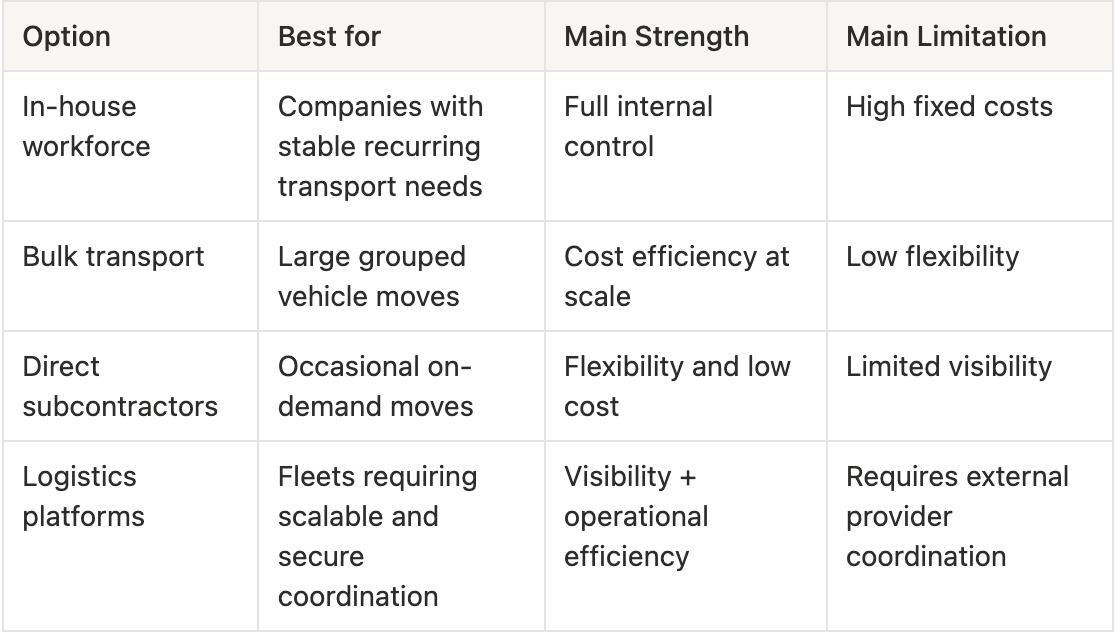
Comparing the four transport models
Conclusion: Which transport solution is the right fit?
Ultimately, there is no universally best vehicle transport solution, only the one that best aligns with a company’s operational needs, transport volume, and internal organisation. While in-house teams provide direct control, they also come with high fixed costs and management complexity. Bulk transport remains efficient for large, grouped moves, but lacks flexibility. Direct subcontractors offer adaptability and lower costs, although often at the expense of visibility and operational oversight. Vehicle logistics platforms aim to bridge these gaps by combining flexibility, traceability, and coordinated execution into a single scalable solution.
As fleet operations continue to grow in complexity, the real challenge is no longer simply moving vehicles from point A to point B, but doing so efficiently, transparently, and without creating unnecessary operational burden for internal teams.
Sources
- Assuralia (2026). L’assurance, une garantie de confiance vers l’avenir. Retrieved on 11 May 2026 from https://www.assuralia.be/fr
- Demenagement365 (2026). Transport voiture. Retrieved on 7 May 2026 from https://www.demenagement365.be/service-demenagement/transport-voiture/?utm_source=chatgpt.com
- Feu Vert (2023). Tout savoir sur le métier de convoyeur de véhicule. Retrieved on 11 May 2026 from https://www.feuvert-entreprises.fr/conseils/convoyeur-vehicule/?utm_source=chatgpt.com
- Mobvious (2026a). Vehicle logistics solutions for fleets. Retrieved on 11 May 2026 from https://www.mobvious.me/
- Mobvious (2026b). Transport meets technology. Retrieved on 11 May 2026 from https://www.mobvious.me/technology
- Mobvious (2026c). Logistics services tailored to your needs. Retrieved on 11 May 2026 from https://www.mobvious.me/services
- Novadesko (2026). *Coût Réel d'un Employé en Belgique 2026 : Salaire Brut, Net et Charges Patronales. *****Retrieved on 7 May 2026 from https://novadesko.com/fr/blog/cout-reel-employe-belgique-2026?utm_source=chatgpt.com
- Secretariat Social (2026). Comment calculer le coût salarial en Belgique ?. Retrieved on 7 May 2026 from https://www.secretariat-social-belgique.be/engager-personnel/cout-salarial/?utm_source=chatgpt.com
- Transconnect (2026a). Your trusted B2B partner in car transport. https://transconnect.com/en/?utm_source=chatgpt.com. Retrieved on 11 May 2026 from https://transconnect.com/en/faq
- Transconnect (2026b). FAQ. Retrieved on 7 May 2026 from https://transconnect.com/en/faq
Stay informed
Get insights on transport, logistics, and industry trends delivered to your inbox.