Vehicle Transport in Belgium: How Professional Car Logistics Works for B2B Fleets

Introduction
Moving a car from point A to point B sounds simple, however, in Belgium, it rarely is. The country sits at the geographic center of European logistics, with one of the densest road networks on the continent which means more connectivity, but also more congestion, more regional administration, and more ways for transport to go wrong.
For fleet managers, dealerships, and leasing companies, vehicle transport is a direct lever to optimise asset turnaround times, control overhead costs, and mitigate substantial risks.
This guide covers how professional vehicle transport works in Belgium, what it costs, and how to choose between provider models.
Why vehicle transport in Belgium is harder than it looks
Belgium’s landscape and economy create both opportunities and challenges for transport coordinators.
The biggest challenge is heavy traffic and congestion. Belgium has one of the densest road network in Europe, especially around Brussels and Antwerp (Reporter, 2020). A vehicle transport without dynamic routing can lose hours in a single jam, and for a dealership waiting on stock or a leasing company rotating a fleet, those hours compound into missed handovers and idle assets.
The situation is further complicated by Belgium’s multilingual and administratively fragmented market. Operating fluidly across Flanders, Wallonia, and the Brussels-Capital Region requires a deep understanding of local regulations and paperwork, therefore drivers and dispatchers must handle regional compliance documents correctly and execute handovers with end users in Dutch, French, German or English. Providers without this local depth generate friction: wrong paperwork, stalled handovers, support delays.
Finally, The Port of Antwerp-Bruges is Europe's leading roll-on/roll-off automotive hub, and Zeebrugge handles millions of vehicle movements per year (Automotive Logistics, 2026). ecent surges in EV imports have created terminal yard bottlenecks (The Brussels Times, n.d.), and port congestion cascades directly into domestic distribution. Importers and distributors without a transport partner that has port-side capacity feel the disruption first.
The four core vehicle transport services
Vehicle transport is a highly specialised logistics segment focused on the secure and efficient movement of automotive assets between distinct operational points. For corporate fleets, this requirement extends far beyond simple point-to-point relocation, encompassing a range of targeted service models designed to maximize asset utilisation.
Professional vehicle transport in Belgium falls into four service types.
- Single-driver delivery and return services: the most frequent operational request. A professional driver collects a vehicle from any corporate or private location, drives it to the destination, and completes a documented handover, including return legs or reverse logistics where needed. This is the standard model for lease deliveries, employee handovers, and single-vehicle repositioning.
- Technical Inspection logistics: Belgian regulation requires a first technical inspection four years after registration, then annually (Belgium.be, n.d.). Managing this internally ties up staff time on booking, driving, and waiting, whereas dedicated providers handle the full cycle: booking the appointment, driving the vehicle to the inspection center, staying with it through testing, and returning it. For leasing fleets rotating thousands of vehicles, this is one of the highest-friction processes to keep in-house.
- Open and closed trailer transport: for grouped moves or vehicles that must arrive with zero added mileage, trailer transport is the answer. Open multi-car carriers are the cost benchmark for volume flows: fleet transfers, remarketing, dealer-to-dealer stock moves. Closed trailers serve high-value or exhibition vehicles that need full protection in transit. As covered in our comparison of transport models, trailer transport is most efficient early in the vehicle supply chain, with importers and distributors moving volume between fixed points, and less suited to fragmented end-customer deliveries.
- Customised fleet solutions and operational add-ons: complex fleet workflows need more than transit: refueling or EV charging on delivery, extended handover protocols, event logistics, on-site remarketing coordination, and commercial Z/V plates to legally move unregistered vehicles.
Who uses professional vehicle transport: B2B and B2B2C flows
In Belgium, where company cars account for a large share of passenger vehicle registrations, professional transport demand splits into two flows.
- Pure B2B Fleet and Remarketing Operations: Leasing companies, dealership networks, and fleet operators need vehicles moved to keep assets turning. At lease end, vehicles must be collected, routed through inspections, and repositioned to auction centers or centralised storage facilities. Similarly, fleet managers require synchronised multi-car transport between regional hubs. Speed matters here: every day a vehicle sits untransported is a day it earns nothing.
- B2B2C Employee and End-User Delivery Solutions: When the recipient is an employee receiving a company car or a retail customer completing an online purchase, the transport provider acts as an extension of the client's brand. That means precise home deliveries scheduled around the employee's day, concurrent return of the outgoing vehicle, and a handover experience the client would put their own name on.
It is precisely within this intersection of high-volume B2B logistics and high-touch B2B2C execution that integrated platforms like Mobvious establish the industry benchmark. By deploying a specialised infrastructure capable of shifting between single-driver handovers and high-capacity trailer transport, Mobvious provides organizations with a comprehensive framework to manage their entire automotive requirements.
How a digital vehicle logistics workflow works
Redefining vehicle logistics requires replacing fragmented, manual communication with a fully unified, digital ecosystem that synchronises every operational stage from initial request to final compliance archive. While traditional market players often rely on manual emails, phone calls, or passive marketplaces where independent operators bid on jobs, advanced B2B and B2B2C platforms like Mobvious standardise the workflow across a central infrastructure. This friction-free experience is engineered across a centralised three-platform architecture designed to eliminate administrative overhead and provide complete visibility.
The process initiates when a business inputs transport details, fleet specifications, specialised service add-on requests, and scheduling parameters into our Client Portal. Rather than facing unpredictable spot-market negotiations, the client receives an instant, fixed cost projection. Once the booking is finalised, a centralised dispatch team, supported by AI optimisation, evaluates driver real-time availability, routing, and proximity, systematically allocating the mission to the optimal trusted driver partner to minimise transit delays on the requested date.
On the scheduled date of transit, the assigned professional executes the mission entirely through a proprietary mobile Driver App. Upon arrival at the vehicle's origin point, the driver initiates a precise handover protocol driven by an electronic checklist, documenting the asset's exact physical condition with time-stamped digital photography before securing the keys.
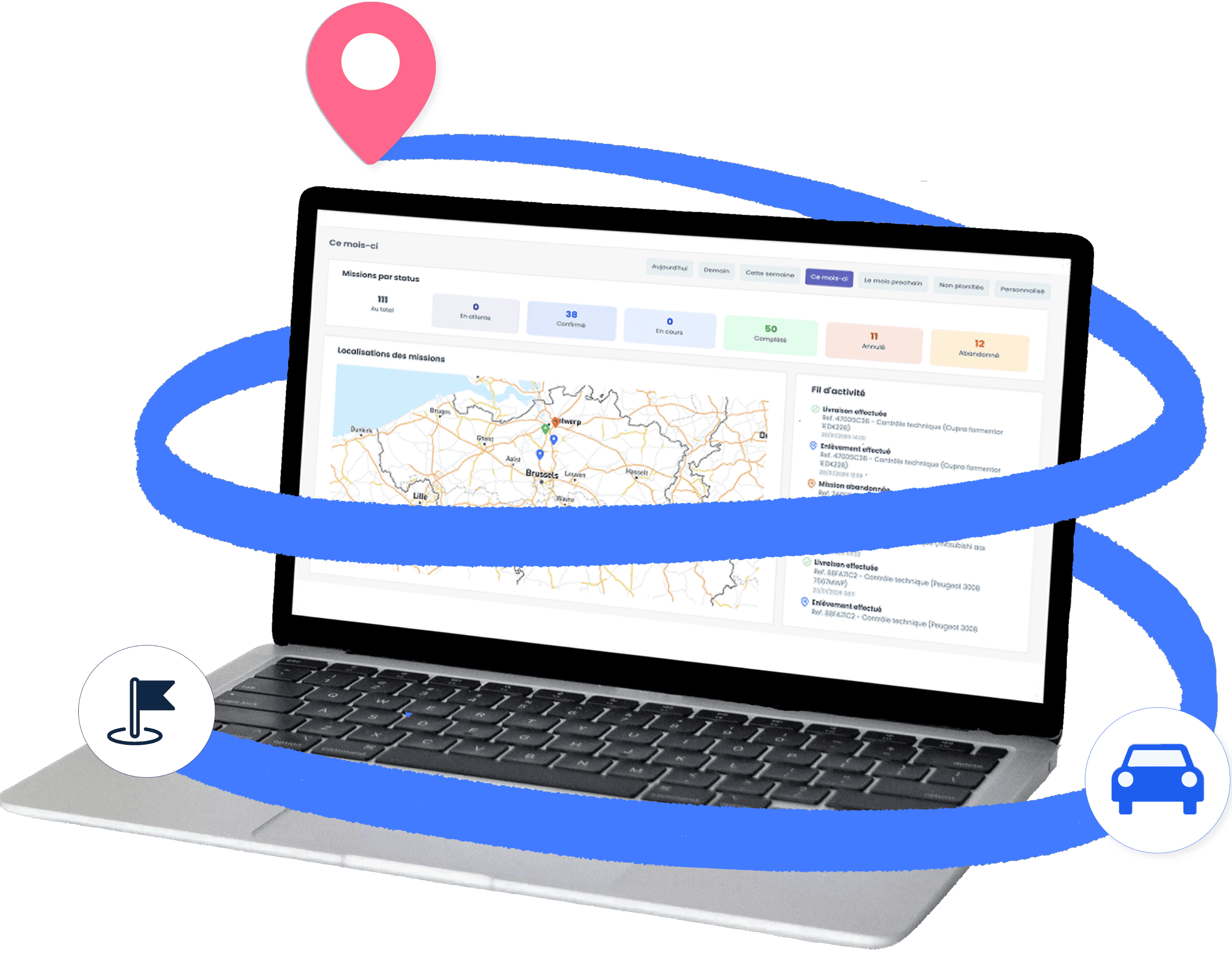
As soon as the vehicle is collected, the Mobvious platform addresses a primary pain point of corporate fleet managers: the total absence of transit visibility. Through live track-and-trace capabilities, the system streams real-time GPS coordinates directly to the client dashboard, accompanied by automated multi-channel status updates via SMS and email. This end-to-end visibility setup completely removes the administrative burden of manual tracking inquiries or driver check-calls.
The operational loop securely closes upon arrival at the destination point, where the driver conducts a second inspection to verify asset integrity. Immediately following a successful handover, the ecosystem compiles a digital archive comprising trip metadata, before-and-after condition reports, and electronic confirmation signatures. This centralised record is instantly accessible and downloadable via the Client Portal, ensuring total administrative protection against future condition disputes or lost paperwork.
What vehicle transport costs in Belgium
The financial framework of vehicle logistics in Belgium is impacted by a series of operational variables, including transit distance, transport method, timing constraints, and specialised administrative compliance.
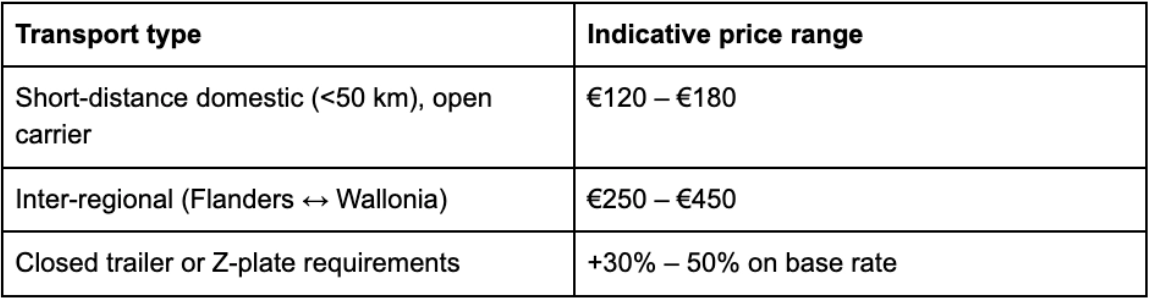
Baseline entry costs fluctuate heavily. Currently, the industry standard for short-distance domestic transport (under 50 km) using a multi-vehicle open carrier ranges from approximately €120 to €180, while inter-regional routes traversing from Flanders to Wallonia typically adjust the benchmark to a range between €250 and €450. When operational requirements necessitate additional support, these standard rates frequently incur an upward adjustment of 30% to 50%, varying strictly on load complexity and required cargo insurance valuation (Open Car Trailer BE, n.d.).
However, headline rates only tell part of the story. The provider's operating model determines the total cost:
Freelance driver marketplaces compete on low entry rates. But transactional pricing fluctuates during peak demand, quality control is inconsistent across an anonymous driver pool, and availability of compliant Belgian commercial plates isn't guaranteed. The spot rate is low; the hidden coordination and risk costs are not.
Secondaly, global automated fleet platforms offer standardised pricing, typically a platform fee plus per-transaction costs, and are competitive for short urban moves. Their weakness in Belgium is local depth: multi-regional technical controls and multilingual handovers create administrative friction and support delays that show up as indirect cost.
Finally, dedicated operational platforms like Mobvious price differently: fixed, all-inclusive quotes generated instantly through the client portal. No spot-market volatility, no surprise yard storage fees, no dispute costs from undocumented handovers. For fleet operators managing recurring volume, predictability is worth more than the lowest single-move rate.
Outsourcing transport is often framed as giving up operational control. That's true of anonymous marketplaces. With dedicated providers, drivers are trained on the client's in-house processes and protocols, so the transport operates as an extension of the client's own team.
6. Strategic Selection: Choosing the Optimal Partner
The right model depends on your volume, route pattern, and how much the end-user experience matters. Our guide How to Transport a Car in Belgium: Four Options Compared breaks down the trade-offs between in-house workforces, bulk carriers, direct subcontractors, and logistics platforms.
Ready to cut turnaround times and simplify vehicle logistics across Belgium? Request a tailored B2B quote from our team.
Sources:
Open Car Trailer BE. (n.d.). https://www.dockx.be/en/our-fleet/trailers/open-car-trailer-be
Reporter, G. S. (2020, February 3). Five reasons Belgium has the worst traffic in Europe. The Guardian. https://www.theguardian.com/cities/2014/aug/28/belgium-worst-traffic-europe-brussels-antwerp-congestion
Vehicle inspection | Belgium.be. (n.d.). https://www.belgium.be/en/mobility/vehicle_registration_service/vehicle_inspection
Williams, M. (2026, April 16). Automotive traffic through Antwerp Bruges levels out in 2025. Automotive Logistics. https://www.automotivelogistics.media/vehicle-logistics/auto-traffic-through-antwerpbruges-levels-out-in-2025/2644100#:~:text=The Port of Antwerp-Bruges,2 min
Stay informed
Get insights on transport, logistics, and industry trends delivered to your inbox.